


The benefits of hiring an outsourced CFO come down to one trade: senior financial leadership without the salary, benefits, and long-term commitment of a full-time hire. You get strategy, forecasting, cash flow discipline, and investor-ready reporting for $3,000 to $10,000 a month instead of a $438,118 salary. About 22% of U.S. businesses fail in their first year (BLS, 2024), most often on financial missteps this kind of oversight is built to prevent. Here is what an outsourced CFO actually does for a growing company, and how to decide whether the model fits yours.
Key Takeaways
- The benefits of hiring an outsourced CFO include senior expertise, flexible scope, and cost savings: $3,000 to $10,000 per month versus a $438,118 in-house salary before benefits.
- An outsourced CFO reaches full productivity in about 2 to 4 weeks, compared with the 2 to 4 months it takes to recruit and onboard a full-time hire.
- The model fits startups, SMEs, and companies going through fundraising, M&A, or rapid growth. Large enterprises with complex daily operations usually still need a full-time CFO.
- Beyond cost, the value is cross-industry experience, an objective outside view, stronger forecasting, and tighter internal controls.
- NOW CFO provides outsourced, fractional, and interim CFO support on an hourly, as-needed basis, so you pay only for the hours you need.
What is an Outsourced CFO, and How Do They Help Businesses?
An outsourced CFO gives you senior financial leadership without a full-time hire. The sections below cover what the role does, how it differs from an in-house CFO, and the misconceptions worth clearing up first.
What Is an Outsourced CFO?
An outsourced CFO is a senior finance leader you engage on a part-time, project, or contract basis instead of hiring full-time. The role covers financial strategy, cash flow, budgeting and forecasting, risk management, and reporting, without the salary and overhead of a permanent executive.
An outsourced CFO is the right fit when your finances have outgrown bookkeeping but do not yet justify a full-time executive. A few clear signals tell you when you have crossed that line.
How Outsourced CFOs Differ from In-House CFOs
While both outsourced and in-house CFOs aim to provide strategic financial leadership, key differences exist between the two roles:
- Cost Structure: In-house CFOs are full-time employees with associated salaries, benefits, and bonuses. In contrast, outsourced CFOs are engaged flexibly, allowing businesses to pay only for the needed services, resulting in cost savings.
- Experience and Expertise: Outsourced CFOs often bring diverse experience working with multiple companies across various industries. This broad exposure enables them to offer insights and best practices that an in-house CFO, typically immersed in a single company’s operations, might not possess.
- Engagement Flexibility: Outsourced CFOs can be engaged for specific projects or on a part-time basis, providing scalability to match the company’s evolving needs. In contrast, hiring an in-house CFO involves a long-term commitment.
Common Misconceptions About Outsourced CFO Services
Despite the advantages, several misconceptions about outsourced CFO services persist:
- Only for Startups or Struggling Businesses: While startups benefit from outsourced CFOs, established and profitable companies leverage their expertise for strategic planning, financial analysis, and navigating complex financial landscapes.
- Lack of Commitment: Some believe outsourced CFOs are less dedicated than their in-house counterparts. However, outsourced CFOs are equally committed to their clients’ success, as their reputation and future engagements depend on delivering results.
- Limited Services: There’s a misconception that outsourced CFOs only handle basic financial tasks. They offer comprehensive services, including strategic planning, risk management, and financial system optimization.
Key Industries That Benefit from Outsourced CFOs
Various industries find significant value in outsourced CFO services, including:
- Technology and SaaS
- Healthcare
- Manufacturing
- Nonprofits
Why Is Demand for Outsourced CFOs Rising?
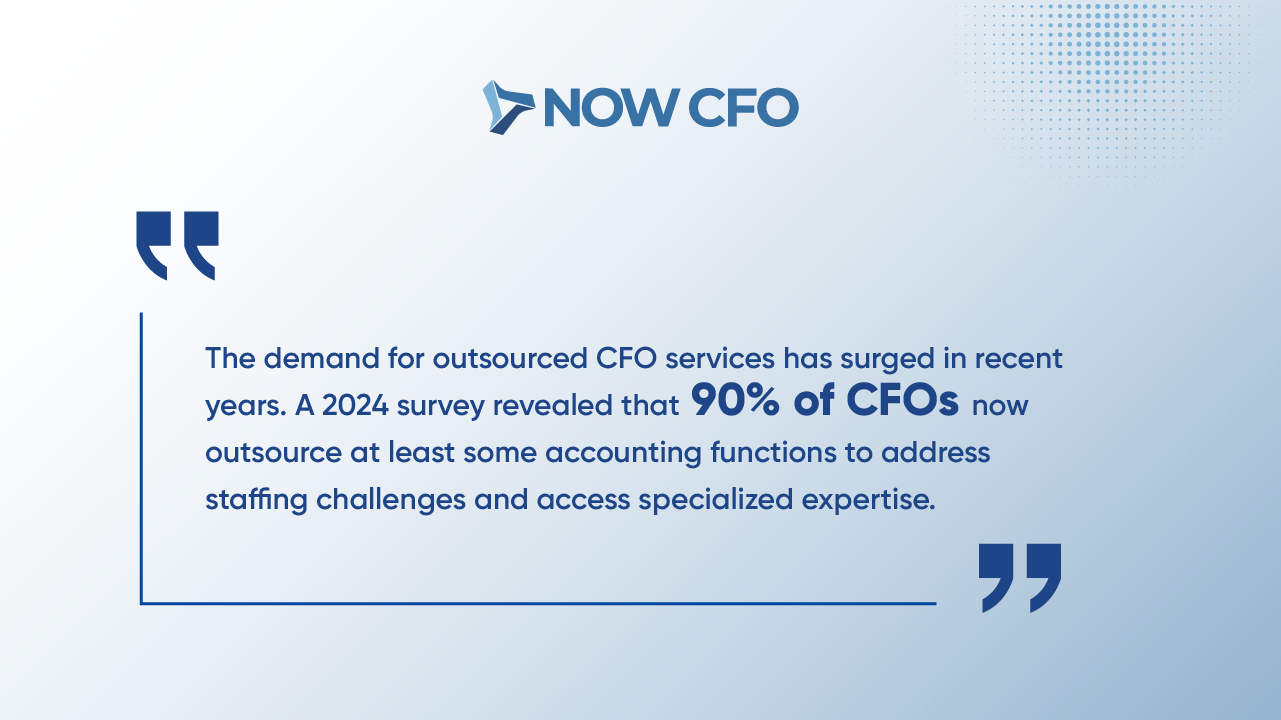
Demand for outsourced finance leadership has climbed as hiring has stayed tight. In a 2024 CFO Pulse survey reported by CFO.com, most finance chiefs said they now outsource at least some accounting functions to cover staffing gaps and reach specialized skills.
What Are the Main Benefits of Hiring an Outsourced CFO?
An outsourced CFO delivers most of what a full-time hire does, at a fraction of the cost and commitment. The core benefits:
- Lower cost: $3,000 to $10,000 per month instead of a $438,118 salary plus benefits.
- Cross-industry experience: a CFO who has solved your problem at other companies, not just one.
- Flexibility: scale hours up for a fundraise or audit, down when things are steady.
- Faster start: productive in 2 to 4 weeks, versus 2 to 4 months to hire in-house.
- Objective perspective: an outside expert who spots issues an internal team stops seeing.
- Stronger forecasting and controls: better cash flow visibility and tighter fraud prevention.
How Much Does an Outsourced CFO Save You?
An outsourced CFO costs $3,000 to $10,000 per month, against an average in-house CFO salary of $438,118 before benefits. For most growing companies, that is the difference between six figures a year and a scoped monthly fee, with the same senior expertise. Here is where the savings come from.
Reducing the Expenses of a Full-Time CFO Hire
Hiring a full-time CFO is a major commitment: salary, benefits, bonuses, recruiting fees, and the months it takes to find the right person. The average in-house CFO salary is $438,118 per year before benefits, bonuses, and equity. An outsourced CFO gives you the same senior expertise for $3,000 to $10,000 per month, with no benefits load, no recruiting cost, and no long-term contract. The table below shows where the money goes.
| Cost factor | Full-time in-house CFO | Outsourced CFO |
|---|---|---|
| Base salary | $438,118 per year (salary.com, 2026) | None; billed per engagement |
| Benefits and bonuses | Add roughly 20% to 30% of salary | None |
| Typical engagement cost | Full salary plus overhead, year round | $3,000 to $10,000 per month, based on scope |
| Recruiting and severance | Executive search fees, plus severance risk | None |
| Time to full productivity | 2 to 4 months to hire and onboard | 2 to 4 weeks |
Flexible Financial Leadership Without Long-Term Commitment
Business needs fluctuate, and the flexibility to scale financial leadership accordingly is invaluable. Outsourced CFOs offer services tailored to the company’s current requirements without the obligation of a long-term employment contract.
- Project-Based Needs: Engaging financial expertise for specific projects such as mergers, acquisitions, or system implementations.
- Interim CFO Solutions: Filling leadership gaps during transitions or searching for a permanent CFO.
- Scaling Operations: Adjusting the level of financial oversight for growing businesses.
Improved Budgeting and Cash Flow Management
Effective budgeting and cash flow management are critical to a company’s financial health. Outsourced CFOs bring specialized expertise to these areas, assisting businesses in:
- Developing accurate budgets
- Monitoring cash flow
- Financial forecasting scenarios
Maximizing Profitability Through Cost Control Strategies
Identifying and managing costs effectively directly impacts a company’s profitability. Outsourced CFOs contribute by:
- Analyzing expenditures
- Implementing cost-saving initiatives
- Monitoring financial performance
Return on Investment (ROI) of Outsourced CFO Services
Investing in outsourced CFO services yields measurable returns through cost savings and improved financial performance. The ROI can be observed in:
- Reduced overhead costs
- Enhanced financial decision-making
- Increased profit margins
How Does an Outsourced CFO Drive Business Growth?
Strategic growth runs on financial management that connects to the plan: capital allocated to the right initiatives, forecasts that hold up, and reporting leadership can act on. An outsourced CFO brings that discipline without the cost of a permanent hire.
Aligning Financial Planning With Your Goals
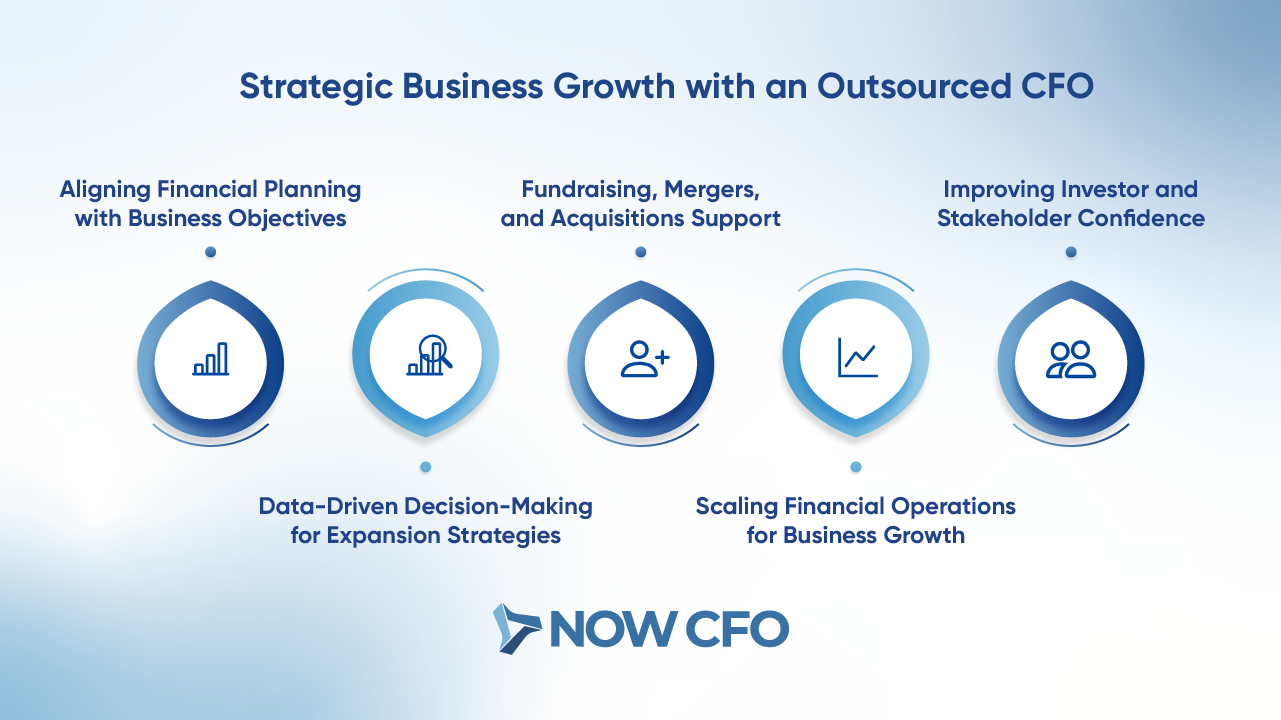
Effective alignment between business financial planning and objectives is crucial for sustainable growth. An outsourced CFO ensures financial strategies are tailored to support the company’s mission and long-term goals.
By building financial planning into the strategic framework, a business can allocate resources against its real priorities instead of spreading them evenly and hoping. That is the difference between a budget that reacts to last month and one that funds where the company is going.
Learn More: How an Outsourced CFO Supports Fiscal Year-End Planning
Data-Driven Decision-Making for Expansion Strategies
An outsourced CFO turns your data into expansion decisions, analyzing financials and market signals to surface trends, opportunities, and risks before you commit capital.
An outsourced CFO builds forecasting models from your own history: past financials, seasonal patterns, and the economic signals that actually move your market. That turns a spreadsheet of last year’s numbers into a projection you can plan hiring, inventory, and cash against.
Fundraising, Mergers, and Acquisitions Support
Dealing with the complexities of fundraising and M&A requires specialized financial expertise. External CFO support is valuable in these areas:
- Preparing financial documentation.
- Valuation analysis
- Due diligence
- Negotiation support
- Business restructuring
Scaling Financial Operations for Business Growth
As businesses expand, their financial operations must scale accordingly to support increased complexity and volume. Outsourced CFOs are central to this scaling process. They contribute by:
- Implementing scalable systems
- Process optimization
- Technology integration
Building Investor and Stakeholder Confidence
Maintaining transparency and demonstrating sound financial management are key to building and retaining investor and stakeholder confidence. Outsourced CFOs contribute to this by:
- Enhancing financial reporting
- Implementing strong internal controls
- Communicating strategic vision
Getting Ready to Raise, Sell, or Exit
When you raise capital or sell the business, buyers and investors judge you on your numbers. An outsourced CFO gets the financials clean, builds the model and data room, and can walk an investor through the story without hesitation. Companies that engage a CFO before a raise or sale routinely negotiate from a stronger position because the numbers hold up under scrutiny.
How Does an Outsourced CFO Reduce Risk and Keep You Compliant?
An outsourced CFO reduces risk by finding financial exposures early, tightening internal controls, and keeping your reporting compliant with the standards that apply to your business. The result is fewer surprises and less regulatory exposure.
Identifying and Mitigating Financial Risks
Outsourced CFOs are central to proactively identifying financial risks that could impact a company’s stability and growth. They conduct comprehensive risk assessments to uncover vulnerabilities in cash flow management, investment strategies, and market exposure.
Key Activities
- Risk Assessment: Evaluating financial processes to identify areas susceptible to risk.
- Strategy Development: Creating customized plans to address and mitigate identified risks.
- Continuous Monitoring: Regularly reviewing financial activities to promptly detect and respond to new risks.
Regulatory Compliance and Financial Accuracy
Keeping up with changing financial regulations requires meticulous attention to detail and up-to-date knowledge of applicable laws. Outsourced CFOs ensure that a company’s financial reporting adheres to relevant standards and regulations, avoiding legal penalties and reputational damage.
Compliance Measures
- Regulatory Monitoring: Staying informed about changes in financial regulations and adjusting company policies accordingly.
- Internal Audits: Conduct regular audits to ensure adherence to financial reporting standards.
- Employee Training: Educating staff on compliance protocols and ethical financial practices.
Internal Controls and Fraud Prevention Strategies
Implementing strong internal controls is essential to prevent fraudulent activities and financial mismanagement. Outsourced CFOs design and enforce control systems that detect and deter fraud, safeguarding company assets.
Fraud Prevention Tactics
- Segregation of Duties: Dividing responsibilities among employees to reduce the risk of collusion and unauthorized actions.
- Access Controls: Restricting access to financial systems and sensitive information to authorized personnel only.
- Regular Reconciliations: Performing frequent reconciliations of accounts to identify and address discrepancies promptly.
Stronger Corporate Governance and Accountability
Strong corporate governance is foundational to a company’s success and sustainability. Outsourced CFOs contribute to this by promoting transparency, accountability, and ethical decision-making within the organization.
Governance Enhancements
- Policy Development: Establishing clear policies and procedures for financial management and reporting.
- Board Reporting: Providing regular, comprehensive reports to the board of directors to facilitate informed oversight.
- Ethical Standards: Fostering a culture of ethics and integrity throughout the organization.
Managing Economic Uncertainty with Expert Financial Guidance
Economic fluctuations present challenges that require adept financial navigation. Outsourced CFOs offer expert guidance to help companies adapt to changing economic conditions, ensuring resilience and continuity.
Adaptive Strategies
- Scenario Planning: Developing multiple financial scenarios to prepare for various economic outcomes.
- Cost Management: Identifying areas to reduce expenses without compromising operational efficiency.
- Diversification: Exploring new markets or product lines to spread risk and create additional revenue streams.
Outsourced CFO vs. Other Financial Leadership Options: Which Is Right?
Selecting the appropriate financial leadership is crucial for a company’s success. Understanding the distinctions between various CFO options can help businesses make informed decisions.
| Factor | Outsourced CFO | Full-time CFO | Fractional CFO | Financial controller |
|---|---|---|---|---|
| Focus | Strategy, forecasting, growth, on demand | Full strategic and operational finance ownership | Ongoing strategic finance, part-time | Historical accuracy, reporting, compliance |
| Cost | $3,000 to $10,000 per month | $438,118 salary plus benefits | Monthly retainer, less than full-time | Salary, below CFO level |
| Engagement | Project, interim, or ongoing; scalable | Full-time, long-term | Recurring set hours across clients | Full-time, internal |
| Time horizon | Forward-looking | Forward-looking | Forward-looking | Backward-looking |
| Best for | SMEs, transitions, fundraising, M&A | Large enterprises with complex daily operations | Companies wanting steady part-time leadership | Companies needing clean books and reporting |
How NOW CFO Delivers Outsourced CFO Services
At NOW CFO, we pride ourselves on delivering best-in-class, cost-effective CFO solutions designed to meet each client’s unique needs. Our approach combines tailored financial strategies, hands-on industry expertise, and advanced reporting tools.
Custom Financial Strategies Tailored to Your Business
Understanding that every business has challenges and goals, we develop custom financial strategies aligned with your objectives. Our outsourced CFOs work closely with you to assess your financial landscape and implement plans that drive growth and profitability.
Key Components of Our Custom Strategies:
- Comprehensive Financial Assessments: Evaluating your current financial health to identify strengths and areas for improvement.
- Goal-Oriented Planning: Setting clear, measurable financial goals that support your business vision.
- Adaptive Solutions: Creating flexible strategies that evolve with your business needs and market conditions.
Hands-on CFO Support with Industry Expertise
Our team consists of seasoned professionals with extensive experience across various industries. This industry expertise allows us to provide hands-on support that is both informed and practical.
Benefits of Our Industry Expertise
- Informed Decision-Making: Using sector-specific knowledge to guide strategic choices.
- Regulatory Compliance: Ensuring adherence to industry regulations and standards.
- Competitive Advantage: Using market trends data to keep you ahead of competitors.
Advanced Financial Reporting and Performance Tracking
Accurate and timely financial reporting is crucial for informed decision-making. We use advanced reporting tools to provide precise insights into your company’s performance.
Features of Our Reporting Services
- Real-Time Data Access: Keeping you updated with the latest financial information.
- Customized Reports: Tailoring reports to focus on metrics that matter most to your business.
- Performance Dashboards: Visual representations of financial data for straightforward interpretation.
Seamless Collaboration with Your Internal Team
We work as an extension of your internal team, staying closely integrated rather than siloed. Our outsourced CFOs communicate effectively with your staff, aligning our efforts with your company’s culture and processes.
Collaboration Highlights
- Regular Meetings: Scheduled sessions to discuss progress, challenges, and next steps.
- Integrated Systems: Utilizing your existing financial systems for consistency and efficiency.
- Transparent Communication: Keeping all stakeholders informed and engaged.
Proven Success Stories of Businesses Partnering with NOW CFO
Our commitment to excellence is reflected in our clients’ success stories. Businesses across many industries have seen real results through our outsourced CFO services.
Client Testimonials
- Doug Martin, CEO at Houston County Community Hospital: “NOW CFO has become an integral part of our management team. Since everything is cleaned up, we can move forward and look to the future instead of being stuck in the present.”
- Lief Larson, Co-Founder & COO at JennyLife: “Over my 25-year entrepreneurial journey, I have worked with many consultants, but they always felt like outsiders. NOW, the CFO is different and feels like part of our team. They rolled up their sleeves and pitched in wherever it was needed. PRICELESS!”
What Are the Common Challenges of Hiring an Outsourced CFO?
Hiring an outsourced CFO comes with a few real challenges: fit with your culture, communication cadence, data security, and a clean handoff during the transition. Each is manageable, and the steps below show how to handle them.
Concerns About External Financial Leadership
Introducing an external leader into your organization can raise concerns about alignment with company culture and objectives. To mitigate this,
- Conduct Thorough Vetting: Assess the outsourced CFO’s experience, industry knowledge, and track record to ensure they align with your business needs.
- Foster Cultural Integration: Facilitate introductions and interactions between the outsourced CFO and internal teams to build rapport and understanding.
- Set Clear Expectations: To ensure mutual understanding, define roles, responsibilities, and performance metrics from the outset.
Ensuring Effective Communication and Collaboration
Effective communication is vital for the success of any outsourced arrangement. To promote seamless collaboration:
- Establish Regular Meetings: Schedule consistent check-ins to discuss progress, challenges, and strategic direction.
- Utilize Collaborative Tools: Implement platforms that facilitate real-time communication and document sharing.
- Define Communication Protocols: Set expectations regarding response times, reporting formats, and communication channels.
Transitioning to an Outsourced CFO Model
Transitioning to an outsourced CFO requires careful planning to minimize disruptions:
- Develop a Transition Plan: Outline steps, timelines, and responsibilities to guide the changeover process.
- Engage Stakeholders Early: Communicate the reasons for transitioning to internal teams to gain support and address concerns.
- Monitor Progress: Regularly review the transition’s effectiveness and adjust as needed.
Protecting Financial Data and Confidentiality
Safeguarding sensitive financial information is paramount when working with external partners:
- Assess Security Measures: Ensure the outsourced CFO employs robust data protection protocols, including encryption and secure storage.
- Implement Confidentiality Agreements: Formalize data handling and confidentiality expectations through legal agreements.
- Limit Data Access: Grant access to sensitive information strictly on a need-to-know basis.
Measuring Success and Performance of Outsourced CFO Services
To evaluate the effectiveness of an outsourced CFO:
- Define KPIs: Establish metrics such as profitability ratios, cost reductions, and forecasting accuracy to assess impact.
- Regular Performance Reviews: Schedule evaluations to discuss achievements, challenges, and areas for improvement.
- Solicit Feedback: Gather input from internal stakeholders to gain a comprehensive view of the outsourced CFO’s performance.
Is an Outsourced CFO Right for Your Business?
An outsourced CFO is the right fit when your finances have outgrown bookkeeping but do not yet justify a full-time executive. A few clear signals tell you when you have crossed that line.
Signs Your Business Needs CFO-Level Financial Guidance
As businesses evolve, sure signs indicate the need for advanced financial leadership:
- Rapid Growth Without Corresponding Profitability: Experiencing swift revenue increases but noticing declining profit margins suggests the need for strategic financial oversight to ensure sustainable growth.
- Complex Financial Transactions: Engaging in mergers, acquisitions, or seeking external funding necessitates sophisticated financial strategies and presentations to stakeholders.
- Cash Flow Challenges: Regular difficulties in managing cash flow can hinder operations and growth, indicating the need for expert financial management.
- Lack of Financial Planning and Budgeting: The absence of structured financial plans and budgets can lead to misaligned resource allocation and missed objectives.
Assessing the Costs vs. Benefits of Hiring an Outsourced CFO
When considering an outsourced CFO, it’s essential to weigh the financial implications:
- Cost Efficiency: Outsourcing provides access to high-level financial expertise without the substantial salary and benefits associated with a full-time CFO.
- Flexible Engagement: Services can be tailored to current business needs, allowing scalability and adaptability.
- Immediate Expertise: Outsourced CFOs bring diverse industry experience, facilitating quick integration and immediate impact.
How an Outsourced CFO Can Solve Common Business Challenges
Virtual CFO benefits can help counter prevalent business challenges:
- Enhancing Cash Flow Management: Implementing reliable forecasting models to effectively predict and manage cash inflows and outflows.
- Strategic Cost Reduction: Analyzing expenditures to identify inefficiencies and implement cost-saving measures.
- Financial Reporting and Compliance: Ensuring accurate financial reporting and adherence to regulatory standards, reducing risk exposure.
Case Studies of the Benefits of Hiring an Outsourced CFO
Real-world examples illustrate the impact of outsourced CFO services:
- General Services Administration Outsourcing Financial Services
The U.S. General Services Administration (GSA) faced challenges with its financial management functions, including excessive staff time spent on financial reporting and a need for improved service delivery.
To address these issues, GSA outsourced some financial and accounting support services to the U.S. Department of Agriculture (USDA). This initiative enhanced GSA’s financial operations and efficiency.
- Farm Credit Administration Outsourcing Financial Management
The Farm Credit Administration (FCA) identified the need to improve the delivery of reliable and timely financial management services. FCA outsourced its financial management services under a shared service agreement following a workforce study. This move aimed to enhance financial reporting and operational efficiency
Steps to Finding the Right Outsourced CFO Partner
Selecting an appropriate outsourced CFO involves:
- Identifying Specific Needs: Determine the financial areas requiring expertise, such as cash flow management, fundraising, or strategic planning.
- Evaluating Experience and Industry Knowledge: Seek professionals with a proven track record in your industry and similar-scale businesses.
- Assessing Technical Proficiency: Ensure familiarity with current financial technologies and software relevant to your operations.
- Checking References and Reputation: Review testimonials and case studies to gauge past performance and client satisfaction.
- Aligning on Engagement Terms: Clearly define the engagement’s scope, duration, and terms to set mutual expectations.
Is an Outsourced CFO Worth It for Your Business
If your business faces financial challenges, expansion uncertainty, or lacks a long-term strategy, NOW CFO can bridge the gap between reactive accounting and proactive financial leadership. The benefits of hiring an outsourced CFO go far beyond cost savings.
We’ve helped thousands of companies across industries scale operations, improve profitability, and impress stakeholders with investor-ready financials. And we’re ready to help you, too.
Not sure where to start? Schedule a free consultation with one of our CFO experts to evaluate your financial needs. Let’s build a brighter financial future together, with NOW CFO by your side.
Frequently Asked
Disclaimer: This content is for general information only and isn’t a substitute for professional accounting, tax, or financial advice. For guidance specific to your business, contact NOW CFO


