


Outsourced accounting services hand your day-to-day finance work to an external team: bookkeeping, payroll, accounts payable and receivable, monthly close, and financial reporting. You get a full accounting function, including controller-level review, without hiring anyone full time. Most businesses engage a provider on a monthly retainer and scale the scope up or down as their needs change.
This guide covers what the service includes, what it costs against an in-house hire, who benefits most, and how to choose a provider. NOW CFO delivers outsourced accounting on an as-needed basis, so you only pay for the hours you need.
Key Takeaways
- Outsourced accounting services cover bookkeeping, payroll, accounts payable and receivable, monthly close, financial reporting, and controller-level review.
- The Bureau of Labor Statistics puts the mean annual wage for accountants and auditors at $93,520, and $52,020 for bookkeeping and accounting clerks, before benefits and overhead.
- Providers price by scope, usually as a monthly retainer, so cost tracks the work you actually need rather than a headcount.
- The clearest signal it is time to outsource: your close takes more than two weeks, or you are making decisions without a current forecast.
- Outsourcing is not the same as offshoring. Ask where the team sits and who signs off on your close, because the two questions have different answers at many firms.
- NOW CFO provides outsourced accounting, controller, and CFO support for growing companies on an as-needed basis, so you get the expertise without a full-time hire. You only pay for the hours you need.
How Does Outsourced Accounting Work?
An outsourced provider takes over named finance tasks, works inside your accounting software, and reports on an agreed schedule. You keep approval authority and visibility. They own the process, the deadlines, and the accuracy of the output.
What Is Outsourced Accounting?
Outsourced accounting is the practice of contracting an external firm to run some or all of your finance function: bookkeeping, payroll, accounts payable and receivable, monthly close, tax preparation, and reporting. The provider supplies the people, the process, and usually the software expertise. You get a complete accounting function at a lower total cost than building the same capability in-house, because you are buying hours of work rather than salaries.
The Five Stages of an Engagement
Most engagements move through the same five stages, and the first one determines how well the rest go:
- Assessment: Evaluating the business’s financial needs to determine which services to outsource.
- Selection: Choosing a reputable accounting firm with relevant industry experience.
- Integration: Aligning the provider’s processes with the company’s operations to ensure seamless collaboration.
- Execution: The external team performs designated tasks, such as managing accounts payable and receivable, processing payroll, and preparing financial statements.
- Review: Regularly assess performance and adjust to meet evolving business needs.
How Much Do Outsourced Accounting Services Cost?
Outsourced accounting is priced by scope, not by headcount. Most providers quote a monthly retainer that reflects your transaction volume, how many bank and credit card accounts need reconciling, whether payroll is included, and how much review sits on top of the outsourced bookkeeping.
That makes the honest comparison a total-cost comparison rather than a rate comparison. Here is what the in-house side actually costs, using national wage data rather than estimates.
What an In-House Accounting Team Costs
The Bureau of Labor Statistics reports mean annual wages of $52,020 for bookkeeping, accounting, and auditing clerks and $93,520 for accountants and auditors as of May 2024. Salary is the starting point, not the total. Add payroll taxes and benefits, which typically run 20 to 30% on top of salary, then software licenses, training, and the cost of covering the role when that person is on leave or leaves entirely.
A single in-house bookkeeper also gives you no separation of duties and no second review, which is a control weakness rather than a cost, but it shows up as one the first time something is missed.
What Changes the Price of an Outsourced Engagement
Four things move the number, in roughly this order:
- Transaction volume. The number of transactions running through your accounts each month is the biggest driver at every provider.
- Scope. Bookkeeping only sits at the bottom. Add payroll, accounts payable and receivable, and monthly close, and it rises. Add forecasting and board reporting, and you are into controller and CFO work.
- Level of review. Whether a controller signs off on your close is the difference most often hidden inside a low quote.
- Complexity. Multiple entities, inventory, revenue recognition, multi-state payroll, and grant or fund accounting all add work.
NOW CFO scopes each engagement on hourly rates with no hidden fees and no long-term requirement, so the monthly number reflects the work in front of you. A short scoping conversation is usually enough to put a real figure on it.
What Do Outsourced Accounting Services Include?
A full engagement covers seven areas: bookkeeping, payroll, financial reporting, accounts payable and receivable, budgeting and forecasting, audit and tax support, and financial planning. Most businesses start with two or three and add the rest as they grow.
Bookkeeping: Recording and Reconciling Every Transaction
Your provider records daily activity through transaction accounting, maintains the general ledger, and reconciles bank and credit card accounts every month. Clean books are what everything else on this list depends on, and they are the first thing an investor, lender, or auditor asks to see.
Payroll: Withholdings, Filings, and Labor Compliance
Payroll is more than issuing paychecks. It covers tax withholdings, benefits deductions, multi-state filing where it applies, and compliance with labor law. Getting it wrong is expensive in penalties and worse in staff trust, which is why it is one of the first functions most businesses hand over.
The U.S. Bureau of Labor Statistics counts 1,448,290 accountants and auditors and 1,455,770 bookkeeping, accounting, and auditing clerks working in the United States as of May 2024. That is a deep national talent pool, and an outsourced provider draws from all of it rather than from whoever happens to be commuting distance from your office.
Monthly Reporting: Statements, Trends, and Metrics
Reporting turns your transaction data into something you can act on. A standard monthly package of business accounting financial statements includes:
- Financial Statements: Balance sheet, income statement, and cash flow statement, prepared monthly.
- Trend Analysis: Identifying patterns to inform strategic planning.
- Performance Metrics: Evaluating key indicators to assess business health.
Accounts Payable and Receivable: Protecting Cash Flow
AP and AR are where cash flow is won or lost. Your provider handles both sides of the ledger:
- Invoice Processing: Ensuring timely payments to suppliers.
- Collections: Following up on outstanding invoices to expedite receivables.
- Dispute Resolution: Addressing discrepancies to maintain positive vendor relationships.
Budgeting and Forecasting: Planning With Real Numbers
A budget tells you what you intended. A forecast tells you what is actually coming. Your provider builds both from your own history, usually as a rolling 12-month budget and a 13-week cash forecast, so you can see a shortfall while there is still time to act on it.
Audit Support, Tax Preparation, and Compliance
Audit and tax work runs on a calendar, and the preparation happens months before the deadline. Your provider covers:
- Audit Preparation: Organizing and reviewing records so the auditors get what they need on the first request.
- Tax Filing and Planning: Preparing and submitting returns, and structuring the year to reduce what you owe legitimately.
- Regulatory Compliance: Keeping filings and reporting aligned with the standards for your industry and states.
- Internal Controls Review: Testing whether your existing controls actually work, and naming the gaps if they do not.
Financial Planning: Connecting the Numbers to the Plan
Once the reporting is reliable, the work shifts from recording what happened to deciding what to do next. At this level a provider offers fractional CFO services, including:
- Strategic Financial Advice: Guidance on investments, cost management, and revenue growth.
- Risk Management: Identifying and mitigating financial risks.
- Succession Planning: Developing strategies for business continuity.
What Are the Benefits of Outsourcing Your Accounting?
Six benefits come up in almost every engagement: lower total cost, access to senior expertise, faster and more accurate reporting, time back for the work only you can do, capacity that scales with you, and a lower risk of errors and fraud. Our guide to the benefits of outsourced accounting goes deeper on each one.
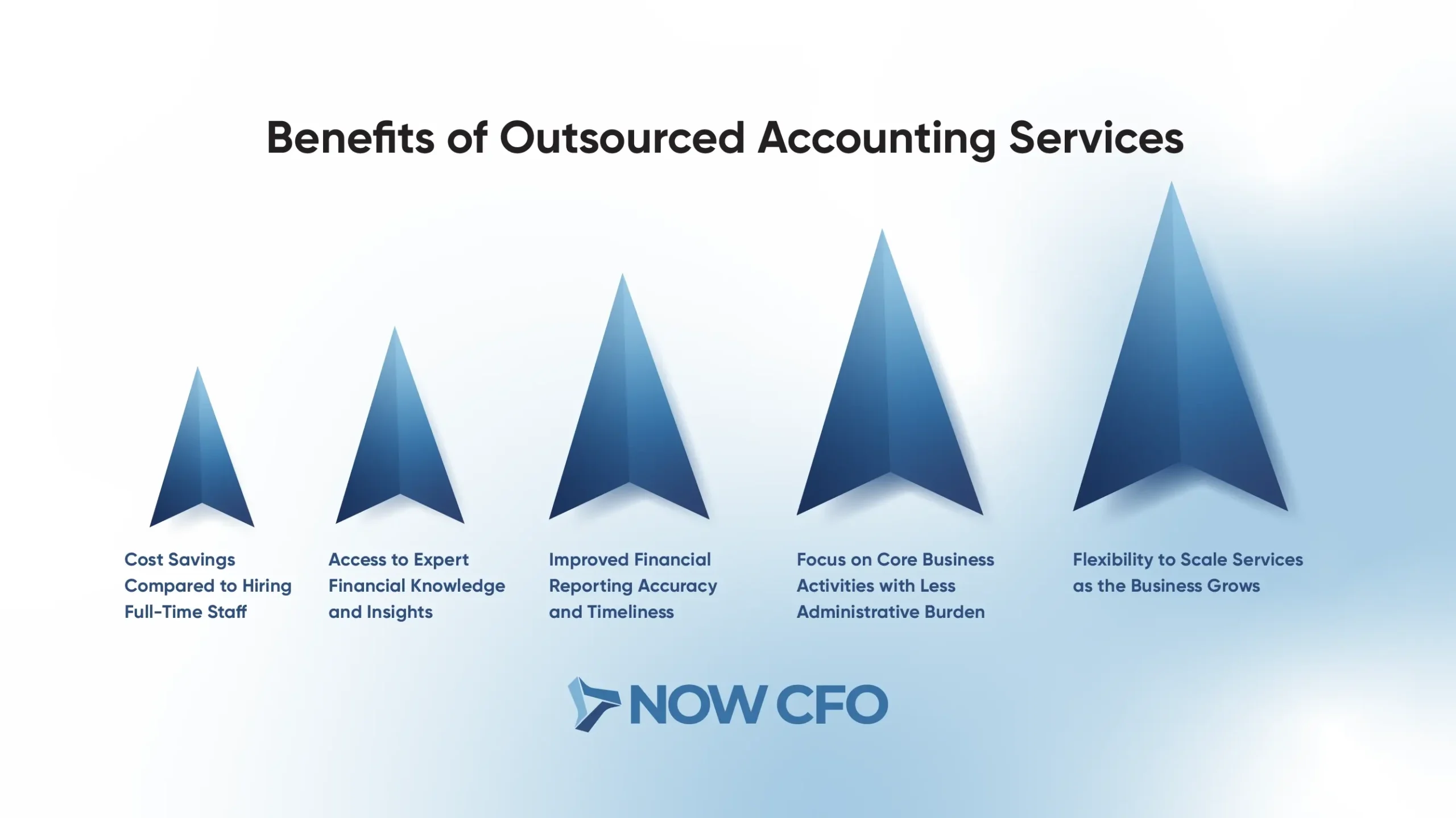
Cost Savings Compared to Hiring Full-Time Staff
An in-house team costs salary plus benefits, training, software, and the overhead of managing the function. An outsourced team costs less because you are buying hours of work rather than a salary and everything attached to it.
Businesses can access a full spectrum of accounting expertise without the overhead costs of full-time employees. This approach allows companies to pay for only the needed services, leading to substantial savings.
Access to Expert Financial Knowledge and Insights
Outsourced accounting firms employ professionals with extensive experience across various industries. This expertise provides businesses with valuable financial insights and strategic advice that may not be available internally.
By using the knowledge of these experts, companies can make informed decisions that drive growth and profitability. Additionally, access to the latest accounting technologies and practices ensures that financial management remains efficient and up-to-date.
Improved Financial Reporting Accuracy and Timeliness
Your provider runs a standardized close process on a fixed calendar, which is why the statements arrive on the same date every month and reconcile to the bank. That predictability is worth more than it sounds: it is what makes a forecast possible.
Fewer errors mean fewer surprises, and a monthly close you can trust is what makes forecasting possible in the first place. Most businesses that move to an outsourced team see their close time drop, which means decisions get made on current numbers rather than numbers from six weeks ago.
Focus on Core Business Activities with Less Administrative Burden
That time back is the benefit owners mention first, and it compounds. More on how outsourcing your accounting frees up leadership time.
Flexibility to Scale Services as the Business Grows
An outsourced engagement scales with you in both directions. Add scope when transaction volume climbs or a fundraise starts, pull it back when things settle. You are not carrying a fixed salary through a slow quarter, and you are not recruiting from scratch when the busy one arrives.
Learn More: What’s Included in Outsourced Bookkeeping Services?
What Outsourced Accounting Will Not Fix
Outsourcing solves a capacity and expertise problem. It does not solve every finance problem, and a provider who tells you otherwise is selling rather than advising.
- It will not fix bad source data. If receipts, invoices, and approvals do not reach your provider, nobody can close your books on time. The handoff process is your side of the arrangement.
- It will not make the decisions. A provider builds the forecast and shows you the shortfall. Choosing whether to cut spend, raise prices, or borrow is still yours.
- It will not clean up years of backlog for free. Historical accounting clean up is real work and is normally scoped as a one-time project before ongoing service starts.
- It will not replace a tax advisor in every case. Many providers handle preparation and planning, but complex tax positions may still need a specialist alongside them.
- It will not give you someone at the next desk. If you need finance in the room for daily decisions, an in-house hire or a hybrid arrangement fits better.
Being clear about this up front is what makes the rest of the engagement work. If two or more of these are your actual problem, say so in the first conversation and the scope can be built around it.
Who Should Consider Outsourced Accounting Services?
Four groups get the most out of an outsourced engagement: small and mid-sized businesses without a finance department, startups that need clean books before their first raise, nonprofits managing restricted funds and grant reporting, and companies whose in-house accountant has just left.
Small and Medium-Sized Businesses (SMBs)
For a business with 10 to 200 employees, a full in-house accounting department rarely pays for itself. Salaries, training, software, and coverage add up well past the cost of an outsourced team doing the same work. Outsourcing also buys access to outsourced controller services and CFO-level review that a small business could not justify hiring outright.
Startups and Entrepreneurs
Startups and entrepreneurs often operate with limited resources and must concentrate on developing their products or services. Outsourcing accounting tasks enables them to focus on business growth while ensuring accurate, compliant financial records.
Clean books also matter more here than most founders expect: the first serious diligence conversation is where messy records cost real money. More on the role of an outsourced accountant for startups.
Nonprofits Managing Restricted Funds
Nonprofits carry a reporting burden most small businesses do not: restricted and unrestricted fund tracking, grant reporting on the funder’s calendar, and a Form 990 that a board will read. An outsourced team that has done fund accounting before will set this up correctly the first time, which is considerably cheaper than correcting it during an audit.
Companies Whose Accountant Just Left
A resignation in a one-person finance function stops your close. An outsourced provider can pick up mid-month, work in the software you already use, and keep reporting on schedule while you decide whether to rehire. It also removes the pressure to hire quickly, which is how the wrong hire usually happens.
When Does a Business Need Outsourced Accounting Services?
Four situations make the case on their own: growth has outpaced your current setup, your team is buried in administrative work, your reports arrive late or wrong, or a tax or regulatory deadline is closing in and nobody owns it. If two of these are true right now, it is time to outsource your accounting.
Rapid Growth or Expansion Requiring More Complex Financial Management
As businesses experience rapid growth, their financial operations become increasingly complex. Managing this complexity demands advanced accounting expertise and systems. Outsourcing provides access to skilled professionals who can handle intricate financial tasks, ensuring accurate management during expansion phases.
Increased Administrative Burden on Internal Teams
When internal teams are overwhelmed with administrative tasks, overall productivity can decline. Outsourcing accounting functions alleviates this burden, allowing employees to focus on core business activities. This shift enhances efficiency and contributes to a more streamlined operation.
Need for Accurate and Timely Financial Reporting
If your close takes more than two weeks, or your reports need correcting after they go out, you are running the business on stale numbers. Your provider closes on a fixed calendar and reconciles before the statements leave, so the numbers you act on are the numbers that hold up.
Challenges in Maintaining Compliance with Tax and Regulatory Standards
Navigating the complexities of tax laws and regulatory requirements can be daunting. Non-compliance poses significant risks, including legal penalties and reputational damage. Outsourced accounting firms specialize in compliance, staying abreast of evolving regulations to ensure businesses adhere to all necessary standards.
How Do You Choose an Outsourced Accounting Provider?
Five things separate a provider who will still be a good fit in three years from one who will not: industry experience, service range, data security, scalability, and pricing transparency. Work through them in that order.
Experience and Expertise in Your Industry
An accounting provider with industry-specific experience understands your business’s unique challenges and regulatory requirements. Their expertise ensures accurate financial management tailored to your sector.
For instance, a provider experienced in healthcare will be familiar with compliance standards pertinent to that field. Assessing a provider’s track record and client portfolio can offer insights into their industry expertise.
Range of Services Offered and Customization Options
A provider that covers the full range of accounting services saves you from stitching together three vendors. Look for bookkeeping, payroll processing, accounts payable and receivable, tax preparation, monthly close, and financial analysis under one engagement.
Additionally, the ability to customize services ensures that the provider can adapt to your requirements, providing flexibility as your business evolves.
Data Security and Confidentiality Protocols
Ask four specific questions: is data encrypted in transit and at rest, who on their team can see your records, what happens to your data when the engagement ends, and can they show you a written confidentiality policy. A provider who answers all four quickly has been asked before, which is the answer you want.
Flexibility and Scalability of Services
As your business grows, your accounting needs will change. A suitable provider should offer scalable services that adapt to your evolving requirements. This flexibility ensures continuity and efficiency in financial management, allowing you to scale services up or down based on your current situation without needing significant adjustments.
Transparent Pricing and Cost Structures
Get the pricing model in writing before you sign, and ask what falls outside it. The three questions that surface hidden costs: what triggers a change in the monthly fee, is there a setup or cleanup charge for the first few months, and who pays for the accounting software licenses. NOW CFO works on hourly rates with no hidden fees and no long-term requirement, so the scope and the number stay tied together.
How Do You Get Started With Outsourced Accounting Services?
Five steps, in order: define the scope, shortlist and evaluate providers, agree deliverables and deadlines in writing, set up how you will communicate, then review performance against what you agreed. Most businesses are through the first three inside a month.
Assess Your Business’s Accounting Needs
Begin by evaluating your current accounting processes to identify areas that require improvement or additional support. Consider factors such as:
- Scope of Work: Decide which tasks to hand over: bookkeeping, payroll, tax preparation, or financial analysis.
- Internal Capabilities: Assess your team’s expertise to identify gaps external professionals can fill.
- Budget Constraints: Establish a budget for outsourcing services to ensure cost-effectiveness.
Research and Evaluate Potential Providers
Once you’ve identified your needs, research potential accounting service providers. Evaluate them based on:
- Experience and Expertise: Look for providers with a proven track record in your industry.
- Service Offerings: Ensure they offer the specific services you require.
- Reputation: Check client testimonials and reviews to gauge reliability.
- Technology Integration: Confirm their use of up-to-date accounting software that is compatible with your systems.
Set Clear Expectations and Goals with the Provider
Establishing clear expectations is crucial for a successful outsourcing relationship. Discuss and document:
- Objectives: Define what you aim to achieve through outsourcing, such as improved accuracy or cost savings.
- Deliverables: Specify the reports and outputs you expect.
- Timelines: Agree on deadlines for deliverables and regular updates.
- Performance Metrics: Set KPIs to measure success.
Establish Effective Communication Channels
Effective communication is vital for seamless collaboration. Set up:
- Regular Meetings: Schedule periodic check-ins to discuss progress and address concerns.
- Designated Contacts: Assign point persons from both sides to facilitate communication.
- Communication Tools: Utilize platforms like email, video conferencing, or project management software to maintain consistent interaction.
Monitor Performance and Adjust as Needed
After implementation, continuously monitor the provider’s performance:
- Review Reports: Regularly assess the accuracy and timeliness of financial reports.
- Solicit Feedback: Encourage input from internal stakeholders to evaluate satisfaction.
- Conduct Audits: Periodically audit processes to ensure compliance and efficiency.
- Make Adjustments: Be prepared to modify the scope of work or address issues as they arise.


