Skip to content
Blog Articles

What is a Fractional Controller?

Publish date 17 Mar 2025

Table of Content

    Our Fractional CFO Services
    Learn More
    What Is a Fractional Controller

    A fractional controller is a part-time, contract-based financial controller who oversees accounting operations for businesses that need controller-level expertise without a full-time hire. Typical work includes the monthly close, financial reporting, budgeting, cash-flow oversight, and internal controls. Engagements usually run 10 to 30 hours per month at $125 to $200 per hour or $2,000 to $7,500 per month on retainer.

    Small and mid-sized businesses need controller-level financial oversight long before they can afford a full-time hire. A fractional controller fills that gap, delivering monthly close, financial reporting, internal controls, and cash-flow oversight on a part-time basis at a fraction of the fully-burdened cost of a permanent employee.

    Key Takeaways

    • A fractional controller is a part-time financial expert who manages the monthly close, financial reporting, internal controls, and cash-flow oversight without the cost of a full-time hire.
    • Engagements run 10 to 30 hours per month, priced at $125 to $200 per hour or $2,000 to $7,500 per month on retainer. That is 70% to 85% less than the $188,000 to $215,000 fully-burdened cost of a full-time controller.
    • Businesses between $1M and $15M in annual revenue are the best fit. If your monthly close takes more than 15 days, your books are unreliable, or you’re preparing for a fundraise or audit, it’s time to bring one in.
    • A fractional controller owns the numbers (“what happened?”). A fractional CFO owns the strategy (“what should we do next?”). Most growing businesses need clean books before they need a CFO.
    • NOW CFO provides fractional controller services on an hourly basis with no long-term commitment, no hidden fees, and no minimum contract across 40-plus U.S. markets.

    What does a Fractional Controller Do?

    Understanding the role of a fractional controller is essential for companies seeking flexible financial management solutions. A fractional controller serves as a part-time financial expert, providing high-level oversight without the commitment of a full-time position.

    Definition and Responsibilities of a Fractional Controller

    A fractional controller (sometimes called a part-time controller or outsourced controller) is a finance professional who works with your business on a part-time or project basis, delivering the expertise of a full-time controller without the associated cost or commitment. The three terms describe the same role and are used interchangeably across the industry.

    • Financial Reporting: Ensuring accurate and timely financial statements.
    • Budgeting and Forecasting: Developing and monitoring budgets to control costs and allocate resources efficiently.
    • Cash Flow Management: Monitoring cash inflows and outflows to maintain operational stability.
    • Strategic Decision Support: Turning monthly financial data into forecasts, variance analysis, and scenario models that leadership can act on.

    Signs Your Business Needs a Fractional Controller

    Consider bringing in a fractional controller when any of these apply:

    • Your monthly close takes more than 15 business days, or you’re not closing consistently.
    • Your bookkeeper is producing statements you don’t fully trust.
    • You’re preparing for a bank line, audit, fundraise, or acquisition within the next 12 months.
    • You’ve outgrown QuickBooks or your current stack but haven’t planned the migration.
    • Your revenue crossed $2M, and you don’t have a monthly forecast or cash-flow projection.
    • You’ve had a fraud, a payroll error, or a compliance surprise in the last 18 months.
    • Your leadership team is making decisions from a spreadsheet that’s older than 30 days.
    • You’re spending founder or CEO time on reconciliations, journal entries, or vendor payments.

    If three or more of these describe your business, you’re past the point where a bookkeeper alone can carry the accounting function.

    When to Hire a Fractional Controller?

    Determining the right time to hire a fractional controller depends on several factors:

    • Rapid Growth: Experiencing quick expansion that complicates financial operations.
    • Financial Complexity: Facing intricate financial transactions or compliance requirements.
    • Budget Constraints: Lacking the resources for a full-time financial expert.
    • Project-Based Needs: Requiring specialized financial skills for short-term projects.

    Engaging a part-time controller in these scenarios ensures the business maintains sound financial practices without overextending its resources.

    Small business owner reviewing monthly financials with a fractional controller

    According to the SBA’s 2024 Small Business Profile, SMEs account for 99.9% of all U.S. businesses. As these businesses expand, the complexity of their financial operations increases, making the expertise of a fractional controller essential.

    Fractional Controller Responsibilities

    Businesses often seek the expertise of a fractional controller to manage critical economic functions. These professionals are central in ensuring the organization’s financial health and compliance.

    Overseeing Financial Reporting and Accuracy

    A fractional controller’s primary responsibility is maintaining accurate and timely financial reporting. They ensure that all financial statements, including balance sheets and income statements, are prepared by GAAP. 

    This close review of every reconciliation and journal entry gives stakeholders a clear view of the company’s financial performance. For instance, the GAO emphasizes that audits provide assurances on the accuracy of actual spending data, thereby increasing the reliability of information used in budget planning.

    Managing Budgeting and Cash Flow

    Effective budgeting and cash flow management are central to keeping the business solvent. A fractional controller develops comprehensive budgets that align with the company’s strategic goals. They monitor cash inflows and outflows to ensure sufficient liquidity for operations. 

    They can also forecast future cash needs by analyzing financial data and implementing strategies to optimize cash reserves. This proactive approach helps prevent cash shortages and supports informed decision-making.

    Ensuring Compliance with Accounting Standards

    Compliance with accounting standards and regulations is required. Fractional controllers stay abreast of the latest financial regulations and ensure that the company’s financial practices adhere to these standards. 

    Furthermore, they conduct regular audits and reviews to identify discrepancies and implement corrective actions promptly. This diligence minimizes the risk of legal issues and financial penalties. 

    According to the U.S. Department of Housing and Urban Development, implementing key internal controls is essential to protect assets and ensure accuracy in financial reporting.

    Strengthening Internal Controls and Risk Management

    Internal controls that catch errors and prevent fraud are vital for mitigating financial risks. A fractional controller assesses existing control systems and enhances them to prevent fraud and errors. They establish procedures for transaction approvals, reconciliations, and access controls to safeguard assets.

    Additionally, they identify potential financial risks and develop strategies to mitigate them, ensuring the organization’s long-term economic stability. By fulfilling these key responsibilities, a fractional controller provides businesses with the financial oversight necessary to operate efficiently and compliantly.

    Benefits of Hiring a Fractional Controller

    Engaging a fractional controller offers numerous advantages for businesses aiming to optimize their financial management. These professionals provide tailored solutions that align with an organization’s specific needs.
    Fractional controller cost comparison chart

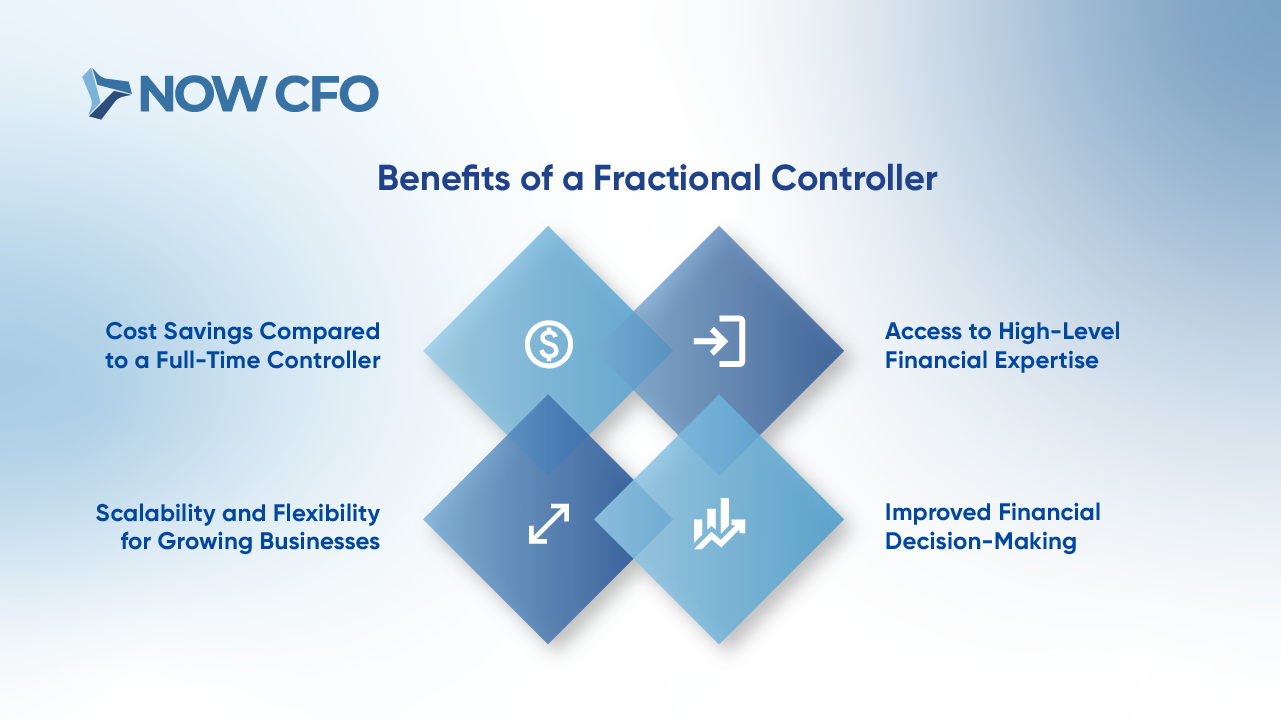
    Cost Savings Compared to a Full-Time Controller

    Hiring a full-time financial controller is a significant investment. According to the U.S. Bureau of Labor Statistics 2024 Occupational Outlook Handbook, the median annual wage for financial controllers is $134,580. Fully-burdened cost, including benefits, payroll taxes, and overhead, typically runs 1.4x to 1.6x base salary, which puts the true first-year cost of a full-time controller between $188,000 and $215,000 for a mid-market hire.

    In contrast, a fractional controller provides the same part-time expertise, allowing businesses to pay only for the services needed. This approach can lead to substantial cost savings, making high-level financial oversight more accessible, especially for small and medium-sized enterprises.

    How Much Does a Fractional Controller Cost in 2026?

    Fractional controller pricing generally follows one of three engagement models:

    • Hourly: $125 to $200 per hour nationally, depending on experience, industry complexity, and market. Rates in New York, San Francisco, and Los Angeles typically run 20% to 30% above the national average. Robert Half’s 2025 Salary Guide is the standard reference point for these ranges.
    • Monthly retainer: $2,000 to $7,500 per month for small to mid-sized businesses. The retainer covers a defined number of hours and a scope agreed upfront.
    • Project-based: A fixed fee for defined deliverables such as audit preparation, an accounting-system migration, a first-time monthly close cleanup, or fundraise-readiness work.

    Most fractional controller engagements land between 10 and 30 hours per month. A typical $3,500 monthly retainer covers roughly 25 hours, which includes an 8- to 12-hour monthly close, 4 to 6 hours of financial analysis and reporting, and the balance in strategic and ad-hoc support.

    Five variables move the price up or down: business complexity (multiple entities, inventory, multi-state operations), industry (construction and healthcare carry more compliance overhead than professional services), close timeline (a 10-day close costs more than a 20-day close), software stack (ERPs like NetSuite or Sage Intacct run higher than QuickBooks), and whether the engagement is hourly, retainer, or project.

    Access to High-Level Financial Expertise

    Fractional controllers bring years of experience from various industries and companies. This diverse background enables them to offer strategic insights and implement the best practices that might not be available internally. 

    By using their specialized knowledge, businesses can enhance financial reporting accuracy, improve internal controls, and make informed decisions that drive growth. This access to high-level expertise ensures that companies can maintain financial management that catches errors before they compound without a full-time controller.

    Scalability and Flexibility for Growing Businesses

    As businesses evolve, their financial management needs can change rapidly. A fractional controller offers flexibility to scale services up or down based on current requirements. Whether a company is experiencing rapid growth or entering a new market, a fractional controller can adjust their level of involvement accordingly. 

    This scalability ensures that businesses receive appropriate financial oversight without the commitment of a full-time hire, allowing them to adapt to changing circumstances efficiently.

    Improved Financial Decision-Making

    Accurate and timely financial information is central to good decision-making. Fractional controllers ensure businesses have access to up-to-date financial data, enabling leaders to make informed choices. 

    By providing detailed analyses and forecasts, these professionals help identify opportunities for cost savings, revenue growth, and operational improvements. This enhanced decision-making capability supports strategic planning and contributes to the organization’s long-term success.

    For More: Benefits of Hiring a Fractional CFO Service

    Fractional Controller vs. Full-Time Controller: Which Do You Need?

    Choosing between a fractional controller and a full-time controller is a critical decision that hinges on several factors unique to your business. Understanding these factors can guide you toward the most suitable option.

    Cost and Resource Considerations

    Financial implications shape this decision. The median annual wage for financial controllers is $134,580 per the U.S. Bureau of Labor Statistics (2024 data). Once you factor in benefits, payroll taxes, and overhead, the fully-burdened first-year cost of a full-time controller typically lands between $188,000 and $215,000.

    In contrast, hiring a fractional controller allows businesses to access high-level financial expertise on a part-time basis, paying only for the services rendered. This approach can lead to substantial cost savings for small to medium-sized enterprises.

    When to switch from a fractional controller to a full-time hire

    A fractional engagement scales up to a point. Consider a full-time controller when:

    • Annual revenue crosses the $10M to $15M range and controller-level work sustains 40-plus hours per week.
    • You’ve added multiple entities, subsidiaries, or a foreign operation.
    • You’re inside 18 months of an IPO, sale, or majority recapitalization.
    • Your board or investor group wants a named, in-house financial owner accountable to them.
    • Your finance function has grown to five or more people and needs an in-house day-to-day manager.

    Below those thresholds, a fractional controller almost always delivers better economics and comparable rigor. Above them, the coordination cost of a part-time engagement usually exceeds the savings.

    Business Size and Financial Complexity

    The scale and intricacy of your business operations are pivotal in this choice. Pew Research Center’s 2024 analysis of small-business demographics found that among the roughly 6 million small businesses with employees, 49% have 1 to 4 workers and 27% have 5 to 19 employees.

    A fractional controller can efficiently manage financial tasks for such businesses without needing a full-time hire. Conversely, larger organizations with complex financial structures may benefit from the continuous oversight provided by a full-time controller.

    Short-Term vs. Long-Term Financial Needs

    Assessing your company’s financial requirements over time is essential. If your business is navigating a transitional phase, such as a merger, acquisition, or rapid growth. A fractional controller offers flexibility to provide expertise during these periods without a long-term commitment. 

    On the other hand, if your organization demands ongoing financial management and strategic planning, investing in a full-time controller ensures consistent leadership and stability.

    DimensionFractional ControllerFull-Time Controller
    Cost (annual)$24,000 to $90,000$188,000 to $215,000 fully-burdened
    CommitmentHourly, retainer, or projectW-2 employee, benefits, PTO
    Time on your business10 to 30 hours per month40-plus hours per week
    Ramp time1 to 2 weeks3 to 6 month recruit, 3 to 6 month onboarding
    Bench depthTeam behind the named leadSingle point of failure
    Best fit revenue range$1M to $30M$30M and above
    Exit cost if not working30 days’ noticeSeverance, replacement recruiting, 5x salary in disruption (per SHRM)

    How To Hire a Fractional Controller?

    Selecting the appropriate fractional controller is crucial for your business’s financial health. To make an informed decision, consider the following aspects:

    Key Qualities to Look for in a Fractional Controller

    When evaluating candidates, prioritize the following attributes:

    • Financial Expertise and Analytical Skills: A firm grasp of accounting principles and the ability to analyze complex financial data are essential. This includes proficiency in financial reporting, budgeting, and forecasting. 
    • Industry Experience: Familiarity with your industry can provide valuable insights and tailored strategies. An understanding of sector-specific challenges enhances their effectiveness. 
    • Adaptability: The financial landscape is dynamic. A competent fractional controller should demonstrate flexibility and the ability to navigate changing business environments. 

    Questions to Ask When Hiring a Fractional Controller

    To assess suitability, pose the following inquiries:

    1. What experience do you have in our industry?
      This determines their familiarity with industry-specific financial practices.
    2. Can you provide examples of how you’ve added value to businesses similar to ours?
      This reveals their track record and potential impact.
    3. What financial management software are you proficient in?
      Ensures compatibility with your existing systems.
    4. How do you approach communication and reporting?
      Clarifies their style and frequency of updates.
    5. Can you provide references from past clients?
      Offers insight into their reliability and performance.

    Working with a Financial Services Firm vs. Independent Contractors

    Deciding between engaging a financial services firm or an independent contractor depends on your business needs:

    Financial Services Firm:

    • Advantages: Access to a team of professionals with diverse expertise; structured processes; scalability.
    • Considerations: Potentially higher costs; less personalized attention.

    Independent Contractor:

    • Advantages: Personalized service; flexibility; often more cost-effective financial management.
    • Considerations: Limited resources; dependency on a single individual’s availability.

    Fractional Controller vs. Fractional CFO

    The roles overlap in title but not in scope.

    A fractional controller owns the accuracy of the numbers. Monthly close, financial reporting, internal controls, GAAP compliance, and cash-flow tracking are the controller’s work. A fractional controller answers the question “what happened?”

    A fractional CFO owns strategy and forward-looking analysis. Budgeting, forecasting, capital planning, banking relationships, investor communications, and pricing strategy are CFO work. A fractional CFO answers the question “What should we do next?”

    Most growing businesses need a controller to work first. Clean books are the input to every CFO decision. Companies that hire a CFO before they’ve stabilized controller-level accounting usually end up paying CFO rates for controller work.

    For a full breakdown, see CFO or controller: which do you need.

    Is a fractional controller the same as an outsourced controller?

    In practice, yes. “Fractional controller,” “outsourced controller,” and “part-time controller” are used interchangeably across the accounting industry. All three describe a controller who works with your business on a contract basis rather than as a W-2 employee.

    Some firms use “outsourced controller” to imply the work is done by a team rather than a single individual, and “fractional controller” to imply a named, dedicated person. The distinction is not standardized, so ask any provider you evaluate exactly who will do the work and how many hours per month you’ll receive.

    A fractional controller provides businesses with expert financial oversight without the expense of a full-time hire. From managing financial reporting to improving cash flow and ensuring compliance, they help companies maintain stability and drive growth. 

    At NOW CFO, we provide fractional controller and CFO services tailored to your business needs. Our team of experienced professionals helps you navigate financial complexities, strengthen internal controls, and make informed decisions that support long-term success.

    Talk to a fractional controller at NOW CFO
    Hourly rates. No long-term commitment. No hidden fees. Serving small and mid-sized businesses across 40+ U.S. markets.
    Get a free consultation Call 801-938-4764


    Frequently Asked

    A fractional controller provides part-time, high-level oversight of accounting operations, such as financial reporting, internal controls, cash flow monitoring, budgeting, and compliance. They act as a bridge between day-to-day accounting and strategic financial governance.
    While both roles have similar responsibilities, a full-time controller is permanently embedded within the organization, handling continuous oversight. A fractional controller serves in a flexible, part-time capacity, ideal when budget constraints exist.
    You might consider hiring one when your accounting complexity increases (e.g., multiple revenue streams, regulatory demands), your budget doesn’t support a full-time hire, or temporary or transitional control expertise is needed (e.g., cleanup, integration, scale).
    Key benefits include cost savings (you pay only for needed time), access to experienced financial oversight, the ability to scale services up or down, improved financial accuracy and internal controls, and strategic insights without the burden of full employment overhead.
    Important criteria include industry experience, technical competence (accounting systems, tools), demonstrated track record, communication style, clarity on scope and deliverables, flexibility, and a good cultural fit with your leadership and finance team.
    Fractional controller monthly retainers typically run $2,000 to $7,500 for small and mid-sized businesses. The number depends on hours committed, business complexity, and industry. Hourly engagements run $125 to $200 per hour.
    Most fractional controller engagements land between 10 and 30 hours per month. A typical mid-market retainer covers around 25 hours, split across the monthly close, financial reporting, analysis, and ad-hoc leadership support.
    Hourly rates for fractional controllers run $125 to $200 per hour nationally in 2026, per Robert Half’s 2025 Salary Guide. Major-metro rates (NYC, SF, LA) typically run 20% to 30% higher. Rates scale with industry complexity, tech-stack fluency, and years of experience.
    Consider a full-time hire when annual revenue passes the $10M to $15M range and controller-level work sustains 40-plus hours per week, or when you’re 18 months from an IPO, sale, or major recapitalization. Below those thresholds, fractional almost always wins on economics.
    The terms are used interchangeably. Both describe a controller who works on a contract basis rather than as a W-2 employee. Some firms use “outsourced” to imply team-based delivery and “fractional” to imply a named individual, but the distinction is not standardized across the industry.
    Yes. Closing the books monthly is core fractional controller work. A well-run engagement produces closed books within 10 to 15 business days of month-end, along with a financial reporting package leadership can review.
    Not always, but a CPA credential is a meaningful trust signal, especially for businesses preparing for audit, fundraise, or acquisition. Ask any provider whether the person doing the work is a CPA, an experienced non-CPA controller, or a mixed team.
    Companies between roughly $1M and $30M in annual revenue are the core fit. Below $1M, a bookkeeper is often enough. Above $30M, controller work usually sustains a full-time hire. The revenue band shifts based on transaction volume, entity structure, and industry complexity.

    Disclaimer: This content is for general information only and isn’t a substitute for professional accounting, tax, or financial advice. For guidance specific to your business, contact NOW CFO.


    Share this post

    Recent Articles

    View All Articles
    How to Build an Annual Operating Plan That Actually Gets Executed Cover
    Articles 9 min read

    How to Build an Annual Operating Plan That Actually Gets Executed

    Read More
    Why Your Business is Profitable but Always Short on Cash and How to Fix It Cover
    Articles 10 min read

    Why Your Business is Profitable but Always Short on Cash and How to Fix It

    Read More
    What is an Annual Operating Plan A Complete Guide for Business Leaders Cover
    Articles 14 min read

    What is an Annual Operating Plan? A Complete Guide for Business Leaders

    Read More

    Don’t Just Take Our Word for It…
    Client Success, In Their Own Words

    We have been overjoyed with the talent NOW CFO brought us. We did not have the staff bandwidth and they have been the perfect fit for our growing company. We were able to find the skillsets we were looking for, and NOW CFO was able to find our unicorn.

    Heath-McMillan
    Heath McMillan

    COO at CKR Financial Services

    NOW CFO was professional, knowledgeable, and courteous. They identified payroll fraud within our company, set up controls to make sure that time stealing did not continue and was instrumental in training our new admin.

    evelyn
    Evelyn Gorman

    President & CEO at GNS Electric Inc.

    NOW CFO has become an integral part of our management team. Since everything is cleaned up, we can move forward and look to the future instead of being stuck in the present. Would recommend them for any type of business.

    doug-martin
    Doug Martin

    CEO at Houston Country Community Hospital

    Because of the current economic climate, it is hard for us to retain staff who are capable of the accounting and CFO work that is needed. We would highly recommend using NOW CFO because of their superior service, value, and business acumen.

    kelcey-alison
    Kelcey Alison

    CEO at Gaming Specialized Logistics

    From the beginning of our relationship, NOW CFO has made us feel like we are in good hands. Our former bookkeepers had created a mess and NOW CFO stepped right in and learned our software and cleaned up the mess rapidly.

    Kevin-Gilbert
    Kevin Gilbert

    Office Administrator at Johnson May Law

    Over my 25-year entrepreneurial journey I have worked with many consultants, but they always felt like outsiders. NOW CFO is different and felt like part of our team. They rolled up their sleeves and pitched in wherever it was needed. PRICELESS!

    Lief-Larson
    Lief Larson

    Co-Founder & COO at JennyLife

    I am so glad we chose NOW CFO to help us with our accounting needs. Our controller level support has been phenomenal with the expertise, insights and commitment to our company. If we need anything, they are there and ready to jump in and help.

    Tiffany-Moore
    Tiffany Lacolucci

    Business Performance VP at Moore Fire Protection

    READY FOR YOUR FREE CONSULTATION?

    We provide outsourced, fractional, and temporary CFO, Controller, and operational accounting services that suit the needs of your business.

    For Faster Service 801-938-4764
    • Hourly Rates
    • No Hidden Fees
    • No Long-Term Requirements